
Reasons to Visit London in the Autumn

Published: July 17, 2024

Planning your trip to the English capital? Keep reading to find out why you'll want to avoid the crowds and take in London in the Autumn

While some of you may be mourning the end of long and hot Summer days, we're excited to welcome Autumn! The days are shorter, the air is crisper and despite the odd rain-shower, we've got the lowdown on why you'll want to visit London in the Autumn. From autumn walks through London's parks and cosy pubs to outdoor ice-skating and more, there's plenty going on in London during the Autumn season. So what are you waiting for? Head out and enjoy it!
Beat the crowds

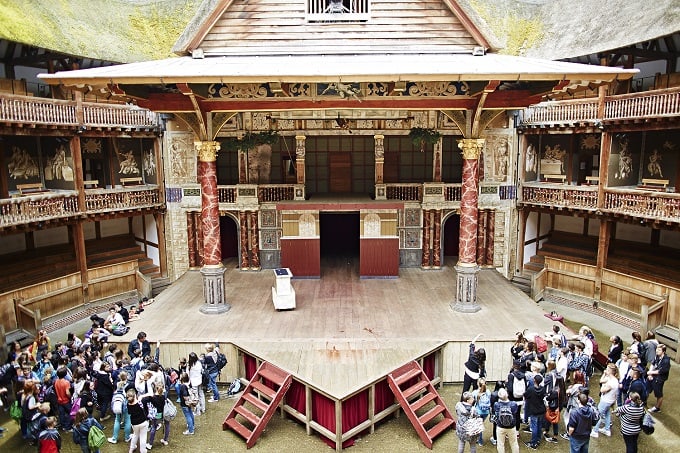
London's top attractions tend to be busy all year round, however, during the Autumn months, the tour groups aren't as regular an occurrence and it is noticeably quieter. Whilst the city is a buzzing hive of tourist activity during the Summer months, a quieter vibe descends upon the city once September rolls around which means less time queuing at attractions such as Westminster Abbey, Tower Bridge and Shakespeare's Globe, and fewer crowds to weave through in the museums so you get more time to see the exhibitions and artefacts.

Layer up

Flex your fashionable muscles and layer up for the chilly Autumn weather! Arguably the most stylish time of year, immerse yourself like a London local with your chic trench coats and knee-high boots!

Spooktacular Fun

While us Brits may not be automatically associated with big Halloween celebrations, you'd be surprised! With a whole month dedicated to the macabre, ghost tours and family-friendly events around town, there's plenty going on through October to celebrate the spooky season. Don't forget to pop by the London Zoo for their annual "Boo at the Zoo" spooktacular with arts 'n crafts, animal demonstrations and hands-on fun!
Autumn Walks

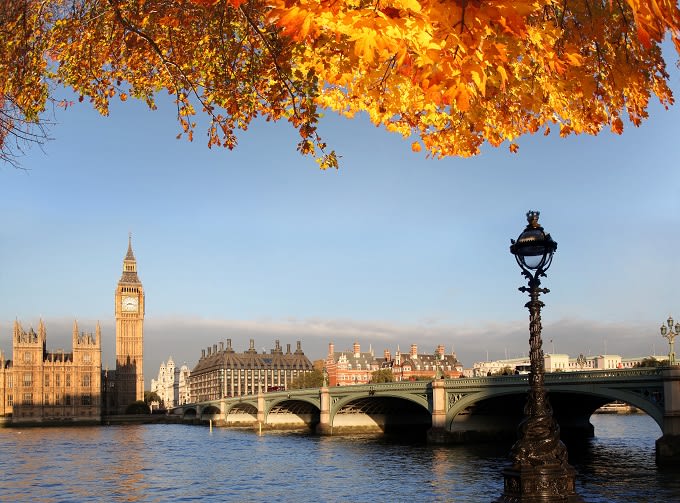
Whether you're strolling along the River Thames, walking through the leaves in Hyde Park or admiring the chestnut trees in Greenwich Park, there's no shortage to outdoor activities in the Autumn. With plenty of green spaces dotted around the city, London's parks and gardens appear to be doused in a golden hue; paired with the crisper temperature, outdoor strolls are an almost compulsory activity if you plan to visit London in the Autumn. Bonus: take a stroll down to the river and hop on a City Cruise boat tour to take in the riverside sights, bathed in a golden Autumn hue.

Wildlife Watching

While we're outdoors - Autumn is a great time of the year to sneak a peek at the wildlife in some of London's green spots. Head over to the London Wetland Centre to see wading birds, ducks, water voles, bats, lizards and otters enjoying the Autumn sunshine.

Cultural Season

When the weather cools down outside, it's time to head indoors and enjoy the range of cultural events during the city's autumn season. From exhibitions and plays to musicals and more, there's plenty of culture to indulge in this Autumn. Don't forget to check out London Pass Concierge where London Pass holders can enjoy exclusive discounts and deals.

Image via Tower of London facebook

Outdoor Ice-skating

Strap on those skates because it's time to hit the ice! Every autumn and winter, iconic attractions around the city set up outdoor ice-skating rinks so you can glide along the ice in the grounds of stunning landmarks such as the Tower of London and the Natural History Museum. Don't forget your gloves!

Museum Wandering

If you're visiting London in the Autumn, there is a chance it can drizzle outside, so if you want to warm up, head to one of London's iconic museums and prepare to lose yourself wandering through all the art and artefacts. Whether you're visiting the mummies at the British Museum, warming up with tea and scones at the V&A or coming face to face with portraits at the National Portrait Gallery, it's easy to spend hours wandering the halls.

Cosy pubs

Us Brits have made a hobby of going to the pub so it's no surprise that in spite of the change in weather, you will still find us gathering with friends down the local pub. The best part about heading to the pub during the Autumn is that the inside becomes a cosy, warm and inviting sanctuary from the cooler outdoors and most pubs start serving heart-warming tipples such as mulled wine and hot toddies.

Vanessa Teo
London Travel Expert

Build your unique London itinerary with our trip planner

Who's going?
Adult
1
Child (5-15)
0
How many days?

What do you want to see?

Continue reading

Blog

The Monument to the Great Fire of London: FAQs

What is The Monument? Is it open to the public? Yes, the Monument is open to the public. In fact, it is the oldest ticketed attraction in London and has around 230,000 visitors come each year to tackle its 311-step spiral staircase and take in the panorama that awaits them at the top. The viewing platform is situated a pretty mighty 160 feet (48.7 metres) above ground level. Where is it? It stands on a plaza where Monument Street and Fish Street Hill meet in the City of London. The location of The Monument is very deliberate. It was erected on the site where St. Margaret’s, Fish Street once stood. St. Margaret’s was the first church to be destroyed during the Great Fire of London. It is also just 202 feet (61 metres) from the baker’s house on Pudding Lane where the Great Fire started on Sunday 2nd September 1666. The fire devastated London, burning for four days before eventually being extinguished near Smithfield. Today, another memorial, named the Golden Boy of Pye Corner marks the spot where the fire was finally put out. Who built it and when was it erected? It was designed by Robert Hooke and Sir Christopher Wren. You’ll certainly recognise the name of the latter: Christopher Wren was instrumental in the rebuilding of London following the Great Fire. His masterwork, undoubtedly, is the iconic St. Paul’s Cathedral, but it’s supremely fitting that he of all people should have a hand in designed a memorial commemorating the Great Fire, and celebrating the reconstruction and rejuvenation of a London reborn in the ashes. Construction began in 1671 and was completed six years later. Is there anything behind its design? How much does it cost to go up The Monument? Tickets are £5 for adults, and £2.50 for kids (5 to 15 year olds). Under 5s go free. And you know how else gets in free? London Pass holders. Yep, access to The Monument (and so much more) is included with the London Pass. Is The Monument accessible? No, unfortunately not. There is no lift to the top of The Monument and the only way up is to take the spiral staircase. It is therefore unsuitable for those with mobilities issues and people in wheelchairs. However, there is still plenty to enjoy and gain from the attraction at ground level. As they say about the Eiffel Tower, the only place in Paris where you can’t see the Eiffel Tower is when you’re up the Eiffel Tower. So it goes with The Monument. Anything else I should be aware of? All bags are checked upon entry and large luggage (wheely cases, big rucksacks etc.) cannot be taken up. There are no storage lockers either, so it’s best to leave your bags back at your accommodation. How do I get there? By tube, head to Monument station, which is on the District and Circle lines. Bank tube station, a transport hub on the Central, Northern, Waterloo and City lines and the DLR, is just a five minute walk from The Monument. By train, the stations which are within walking distance are London Bridge, Cannon Street, Fenchurch Street and Tower Gateway DLR. Thames riverboat services stop at both Tower Pier and London Bridge City Pier. Both piers are within walking distance (around 10 minutes) of The Monument. Bus services stopping at or near The Monument are the 17, 21, 35, 40, 47, 48, 133, 141, 149, 344 and 521. That's it for The Monument FAQs. There's another landmark just down the road. Head over here to find out more.
Matthew Pearson
Kew Gardens
Blog

Top Facts about Kew Gardens

Founded in 1840, The Royal Botanic Gardens at Kew, commonly known as Kew Gardens, is one of the most extensive and important botanical gardens in the world. It's a stunning sanctuary less than 30 minutes from central London, offering a perfect escape from the city buzz. Housing the "largest and most diverse botanical and mycological collections" globally, this UNESCO World Heritage Site is also one of London's most popular attractions. Kew Gardens has more than 50,000 different plants in its living collection and over 7 million preserved specimens. It's not just a pretty space; it's a veritable treasure trove of plant-based knowledge, with over 750,000 volumes and illustrations contained in its library. Discover more about this historical botanical landmark with some of our favourite facts about Kew Gardens below. A stroll through time A little tidbit on the history of Kew Gardens: It's been around for quite a while! Its growth and development over the years have made it one of the most famous gardens in London and indeed, the world. 1. The world's oldest potted plant resides at Kew Housed inside the famous Palm House, the world's oldest pot plant, a huge Jurassic cycad (Encephalartos altensteinii) originally came to Kew in 1775. Plant-hunter, Frances Masson, collected the specimen during one of Captain Cook's voyages from the Eastern Cape of South Africa. 2. It's home to the smallest royal palace in the country After a decade-long restoration project, the Grade I listed Kew Palace was reopened in 2006. The smallest of British royal residences, it was a popular getaway of George III (1760 - 1820). The same size as a small manor house, the palace was gifted to the people by Queen Victoria in 1837. So, Kew Gardens is not just one of the best gardens in London, but also a royal one. 3. It has its own police force For over 150 years, Kew Gardens has had its own police force responsible for on-site security. Established in the mid-1840s, it initially consisted of part-time gardeners and veterans from the Crimean War. The Kew Constabulary originally possessed the same powers as the Metropolitan Police. This meant they were permitted to exercise their force in most London parks, including Battersea Park and Parliament Square. As of 2022, the Kew Constabulary has 20 members of staff and one vehicle, making it one of the smallest police forces in the world.  4. Suffragettes burned the Tea House down On 20 February 1913, Suffragettes Lilian Lenton and Olive Wharry burned down the Tea House at Kew Gardens in one of several arson attacks in the capital. After being caught, they were sentenced to 18 months at Holloway prison. During their incarceration, they both went on hunger strike. They ended up being released within a month. 5. The tube station has its own pub Getting to Kew Botanical Gardens is even more fun knowing that Kew Gardens station has its very own pub! Previously called The Railway, The Tap on the Line pub reopened in 2013. There is still a door near the bar that leads directly to platform one, but it's no longer open to the public. 6. It includes part of the old London Bridge In 1968, the American entrepreneur Robert P. McCulloch bought the 19th-century London Bridge and attempted to move it to Arizona’s Lake Havasu. He thought he was buying Tower Bridge, but alas, no. Around 200 granite blocks didn't make the trip across the Atlantic. Four of those blocks were taken by Kew Gardens and placed on the banks of the big lake near the Sackler Crossing. Consider adding the Royal Botanic Gardens, Kew to your itinerary during your trip with The London Pass®. You'll make great savings on combined admission vs. paying at the gate, and your pass includes entry to dozens more top attractions in the city! 7. Commemorative coins Kew Gardens celebrated its 250th anniversary in 2009 and to commemorate this event, the Royal Mint released a commemorative 50p coin. Only 210,000 Kew coins were minted. This resulted in them soaring in value, selling for over 100 times their monetary worth. 8. Climate control Discover 10 different climate zones at the Princess of Wales Conservatory. From the dry tropics and wet tropics to eight smaller micro-climates, the conservatory ensures that each set of plants' needs are met. 9. Rare heist In 1987, the world's smallest water lily (Nymphaea thermarum) was discovered in Mashyuza, Rwanda. Conservationists saved the plant from extinction after it was grown from seeds at Kew Gardens. In 2014, one of these rare water lilies was stolen from the Princess of Wales Conservatory. 10. An explosive history During the Second World War, the Great Pagoda became the perfect place to test the aerodynamics of bombs in secret. Around 30 high-explosives dropped onto the gardens during the Blitz and the Herbarium, Temperate Houses, Palm House and Waterlily House suffered damage. Experience everything London has to offer with The London Pass® Planning your London trip? With The London Pass®, you can explore big-name landmarks, local hotspots and epic tours, all on one pass, all for one price. Not only that, but you'll enjoy savings of up to 50%, compared to buying individual attraction tickets. ✈️ Buy The London Pass® ✈️
Suz Pathmanathan

Have a 5% discount, on us!

Sign up to our newsletter and receive exclusive discounts, trip inspiration and attraction updates straight to your inbox.